

Acerca de

Writing Across the Curriculum
-
Learning how to write in a second language constitutes one of the most challenging tasks for learners
-
Writing across the curriculum (WAC), including differentiated writing prompts, meets students at their current level of skill and aids them in writing development
-
Cross-cultural writing that involves purposeful short-response writing promotes confidence and motivation leading to academic growth. In this process, the students internalize the learning objective throughout the lesson.
-
Through Project-Based Learning (PBL), multiple learners engage in authentic, open-ended prompts to encourage active cooperative learning.
-
Writing-to-Learn (WTL) involves students in short informal writing tasks frequently in different formats to varied audiences.
-
The use of technology to teach writing yields strong positive results for all learners as it grants the opportunity to provide universally designed literacy instruction aligned with transition goals.
-
WAC is an excellent way for students to showcase what they have learned that includes fiction and non-fiction, and for teachers to evaluate where they are and what we need to do to modify our instruction

Multi-Modal Approach and Strategies
Vygotsky’s theory of ZPD identifies a student’s current ability and learning potential, empowering educators to target pedagogical support at the leading ends of the student’s proximal development zones. Instructional rigor is a critical component of effective instruction where students are encouraged and supported to learn at high levels. To promote rigor, an educator using this method must be cognizant of equipping students to think critically, work collaboratively, synthesize knowledge in real-world situations, and persevere until the objective is accomplished. Evidence-based multimodal instructional strategies can provide a means of modification without diminishing rigor such as:
-
Concept mapping, games, or simulation provide further accommodation and modification in differentiated instruction.
-
Concept mapping enables learners to integrate knowledge and understanding by applying problem-solving examinations visually.
-
Education games promote experiential learning through innovative experiences and reflection.
-
Technology-enabled stimulation further heightens DI by challenging the learner to respond, generating authentic application situations.
-
To tackle mathematical concepts, the use of educational games such as the digital platform, Prodigy adds an extra mode to the learning experience

Identifying Diverse Learners Needs
Cultural diversity constitutes a predominant characteristic in education. Instructors have the entrusted task of actively considering multiple learning strategies to address students, needs, and interests. The two graphs reveal the academic outcome disparities and learner needs for three immigrant groups.
Reflecting on own teaching practices, and beliefs enable self-efficacy relations that contribute to learning. Having strong self-efficacy beliefs foretells future behaviors that lead to success.

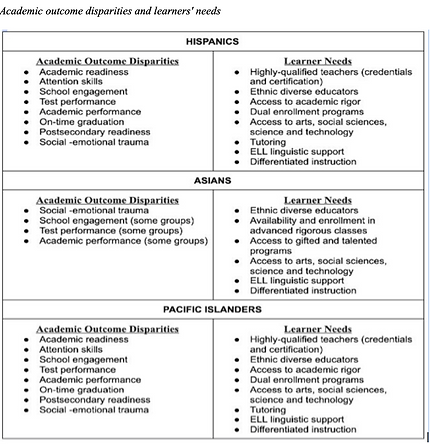
In a study, Lastrapes and Negishi (2012) articulated how educators reflected growth in levels of cultural sensitivity and self-efficacy by engaging in diverse cultural responsive pedagogical experiences. The infographic represents the Theory Framework developed to support Hispanic, Asian, and Pacific Islanders groups. It outlines Hofstede et al. (1990) constituents of pedagogical culture related to academic performance to ensure a pathway to students’ success.
